
I guess you’re familiar with the rosy glow that means you know you’ve done a good job. Three perfectly poached eggs on toast ready to serve, not a single broken yoke. A beautiful flower bed that we planted last year, bursting into bloom. That broken-down wall, now neatly reconstructed, stones in apple-pie order.

But what about those times when others’ achievements surpass anything you can imagine yourself doing? Especially so when it’s you who’s benefitting? We’ve just returned from a trip to Italy, during which we felt humbled by amazing artworks, sculptures and constructions both ancient and modern. We captured photos of the iconic Colosseum at sunset. This magnificent, towering edifice is large enough to accommodate a football pitch. Here, the Roman public was thrilled by chariot racers and gladiators, but here, too, ‘undesirables’, including some Christians, were thrown to the lions.

The Vatican museum contains wonders galore, both sacred and pagan(!). The lifesize statues (dated 2nd century AD) from the gallery of the Muses (mostly Greek goddesses) are perfectly carved, to show both the bones and muscles in the limbs as well as the folds on the muses’ garments. The Gallery of Maps, commissioned by Pope Gregory 13th, contains frescos showing
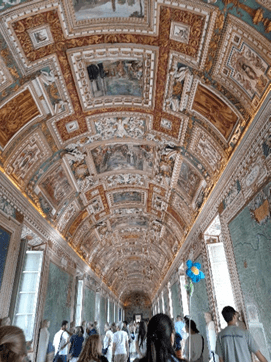
Italy and its surrounding islands. The shapes, created by maths professor Ignazio Dante, are so accurate – how did he achieve this in 1580 -1585? Dante and other artists went on to create the stunning paintings on the ceiling, of saints, martyrs and apostles.

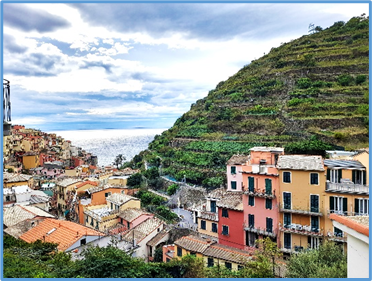
I’ll return to Rome later, and take you to the Cinque Terra (5 lands) villages at the top left of Italy’s boot. Here, fishing communities created the most amazing patchwork of dwellings with foundations hewn out of the rock, often six storys high. The lofty banks above the villages support terraced vineyards and olive groves.

The cliffs here are so steep that these villages were, until 100 years ago, isolated from each other. Manorola (pictured) was connected to its neighbour Riomaggiore in 1931 thanks to the brave efforts of local people, taking advantage of miners’ paths. This so-called ‘Path of Love’ was reconstructed after a landslide in 2012 and was re-opened just in time for our visit. We were staggered by the attention to detail paid by the engineers, who had constructed a pleasant, safe path with interesting features such as rockeries, seating spaces, and a gallery detailing the project.
But some ‘marvels’ impressed us in a different way. Back in Rome, we visited the Catacombs, the underground burial chambers hewn out by Christian and Jewish communities containing 90 miles of tunnels. The picture (taken from a guide leaflet, but we saw a similar one) shows a family burial room with artwork. Typically tombs date from the 2nd century and would feature: Abraham offering Isaac as a sacrifice, Jonah being 3 days in the belly of the fish (used by Jesus to symbolise his death and resurrection); most poignantly for them, Daniel not being eaten by the lions. From the New Testament, the Last Supper, Jesus the Good Shepherd, Jesus’ miracles in the Gospels.
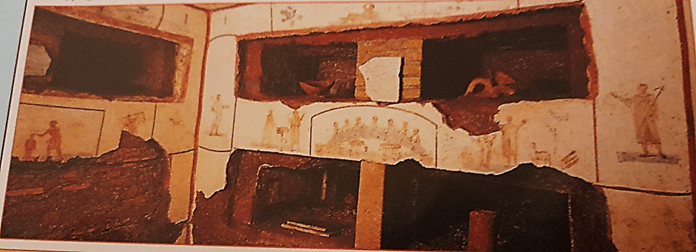
Hold on, we thought. These are scenes that would have meant a lot to us, had we lived then. The creators of these tombs seemed like our own family. So much for those who argue that the Christian message has been distorted beyond recognition by the passage of time!
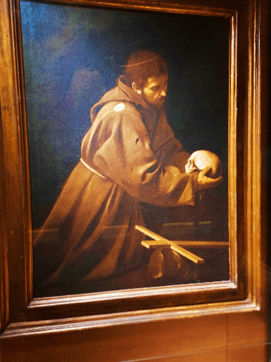
We were moved, too, by a visit to the Capuchin monastery and crypt in Rome, which features several exquisite, if macabre, chapels decorated with dead friars’ bones! The Capuchins were an offshoot of the Franciscans, calling the movement back to its original values of simplicity and service to the poor. The museum contained Caravaggio’s beautiful painting of St Francis contemplating his own life and death…
On the theme of serving the poor, we worshipped at the Episcopalian church of St Paul within the Walls. 70 years ago, this was an entirely English-speaking church which served the American community. Nowadays, worship is in both Italian and English, with a Spanish-speaking group, and on weekdays it hosts the Joel Nafuma Refugee Centre, offering food, friendship, language and skill courses, legal and social advice, and employment support to up to 150 people.
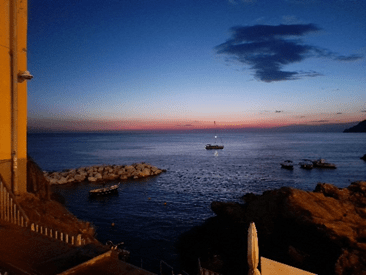
My very last ‘marvel’ is from the night before we left Cinque Terra to return home. This view of the sun’s last glow and the calm, blue sea wasn’t man-made.
 johnhearsonwrites.com
Thank you for sharing this wonderful holiday with me! I have been to
Italy and loved everything it offered. You reignited my memories. Thank you.
LikeLike
It all looks amazing John. Particularly love the sunset photos. Glad you had a wonderful time. I’ll look forward to hearing more details sometime. God bless you both. x
LikeLike
Looks wonderful John, & has whetted my appetite as we have booked to go to Rome for a few nights in January to celebrate Gibs’ 50th birthday!
LikeLike
Thank you so much, John, for sharing this beautiful report. My family really enjoyed visiting some of the same sites in Spring 2023, and seeing your pictures and reading your descriptions has brought it all back! Italy has so much beauty and much fascinating history!
LikeLike
John and Jane, thank you for sharing some of your wonderful experiences with us. What a truly educational and culturally rich trip this was for you both! Living so far away, Darrel and I will likely never visit Italy, so your descriptions were appreciated all the more! However, I feel a musical connection with Italy at the moment as I’m studying an Italian Aria for a music festival next Spring…I find Italian pronunciation rather challenging!
No doubt you both picked up quite a bit of vocabulary…with the word ‘Gelato’ coming into play on frequent occasions!
Love,
Sis Di and Darrel.
LikeLike