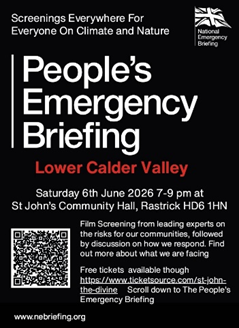
Why, oh why am I doing this? I’m working my socks off to organise the screening of this film, the People’s Emergency Briefing. I pray about how we’ll publicise the film, which projector we’ll use… I live and breathe it.
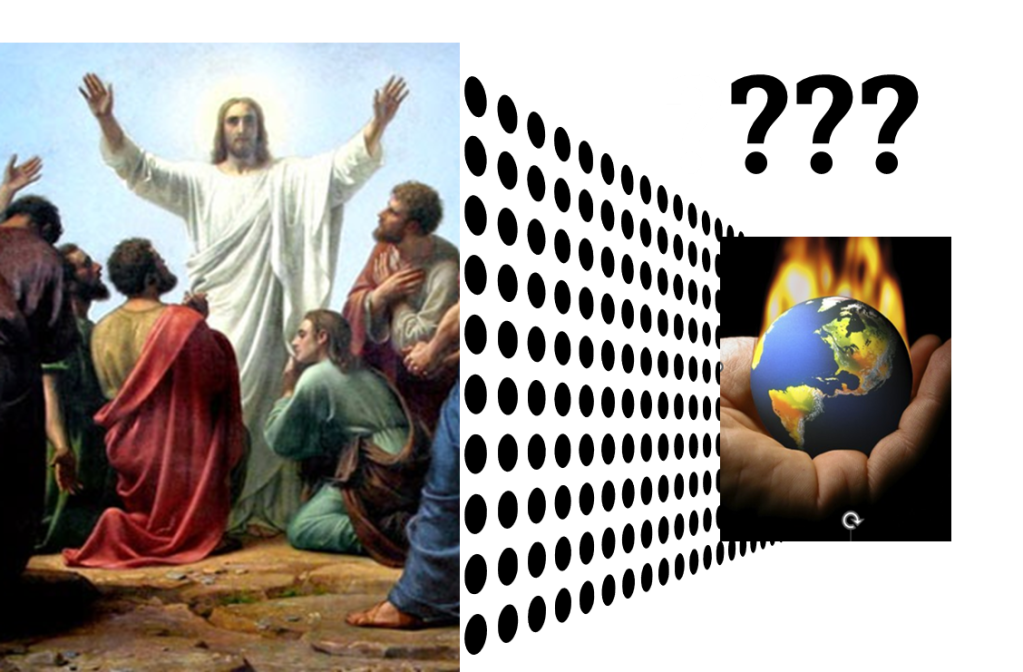
I began this article just before Ascension Day. We were remembering Jesus’ final words to his disciples. What were they? Go and save the planet from destruction? Not exactly. “You are my witnesses,” he said, “so go and make disciples of all nations…” Matthew Chapter 28 verse 19. I learnt it as a 14-year-old. Surely that should be my priority, not jumping onto the Green bandwagon with a load of wacky people from Extinction Rebellion? [See note 1]
Take a closer look. The wording in Mark’s Gospel reads, “go into all the world and proclaim the Good News to the whole creation.” Creation? Yes, okay, the sense is that Jesus meant people. But – does God really intend me to ignore what’s happening, that much of ‘Creation’ is threatened with being lost forever? How can that be ‘Good News’? How can I preach the Gospel to people losing their livelihood to Climate Change when I’m doing nothing about it?
St Paul, in his letters (e.g, to slave master Philemon), didn’t challenge the system of slavery, although he didn’t affirm it. The time to take action came later, when the British Empire was being built on the backs of African slaves deported mainly to the West Indies. A movement grew up to oppose it, which included the Society of Friends (Quakers). The campaigners looked for a man of influence in parliament to take up their cause.
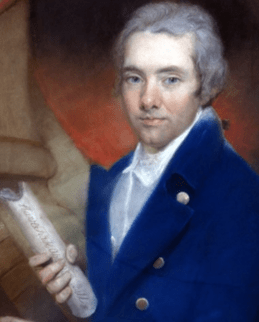
Enter William Wilberforce (pictured). A passionate man of faith, he cared deeply about ‘making disciples’ but campaigned tirelessly against slavery for the rest of his life. He was greatly encouraged by John Newton (who wrote ‘Amazing Grace’), an Anglican clergyman who had formerly been a slave ship master and deeply regretted his involvement. To these men, freeing the slaves was inseparable from the Good News. Slavery was the issue of the day, just as is the Climate and Nature emergency in our own.
-o-O-o-
Perhaps you’re an atheist or agnostic, and you wonder how I can carry on talking about ‘religion’ when our obvious priority is to take urgent action. Lobby your MP. Green up your lifestyle. Make it your passion. If this is you, please read on! Because our Good News makes a world of difference to how we approach the coming emergency.
-o-O-o-
Here are some of the ways our faith makes a difference:
- We treasure Creation because God does [Note 2]. His first comments after creation: “God saw all that he had made, and it was very good.” Psalm 104 describes creation as it was designed to be:
You provide streams of water in the hills and valleys,
so that the donkeys and other wild animals can satisfy their thirst.
Birds build their nests nearby and sing in the trees.
The charity A Rocha was set up to care for nature through fact-finding, partnership and by encouraging churches to become involved in conservation. And the movement has caught on, including the creation of the Eco Church scheme which we belong to.
2. We treasure people because God does.
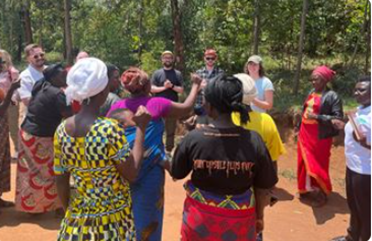
Jesus valued each person he met as being special. He cared for the whole person, body, mind and soul. Increasingly, we’ve become aware of our ‘global neighbours’ who suffer as a result of climate and nature degradation. Charities such as the Tearfund have gone ‘where the need is greatest’, through their Community Transformation programme. Villagers begin to see themselves as God sees them, with gifts and resources that – with a little outside help – can be used to greatly enhance their lives. Likewise the Mothers’ Union. BUT I’m aware that choices made in Britain, e.g., ‘do we build new wind farms or open a new oil/gas field?’ will affect the same villagers’ chances of success. On an individual level, we could make a difference by choosing a non-flight holiday…buying an EV…having solar panels installed.
3. We are prepared to Speak Truth to Power. As in Wilberforce’s day, the world needs brave men and women who will declare the unpalatable truth. The Briefing is just such an example, and it’s encouraging that such a wide range of voices are calling for action. What I see as specifically Christian is that – as St Paul instructed his protégé Timothy – we pray for those in power. It’s important that where we are able to engage with them, we speak to them supportively amidst a culture of negativity [Note 3]. Englishman Robert Glover has been a remarkable Christian example of constructive engagement. He’s been the catalyst for a total change in the way China supports orphaned and uwanted children.
4. Our Hope carries us beyond the present age. I’ll expand on this in my forthcoming companion article, ‘Jesus and the CAN Emergency’. We believe that the God who raised Jesus from the dead, continues to be active in our world, looking forward to the time when heaven and earth are recreated under the rule of Jesus. The climate and nature crisis threatens to destroy our comfortable lives, but he promises always to be with us. I find it so much easier to act positively if I’m not in a state of panic. I believe the church will have a huge role in the days to come, promoting hope, compassion and motivation to change.
I can’t forget the reason why I can pray in faith. It’s only through Jesus’ sacrificial death that I can have a relationship with God, and tap into the power released through his resurrection.
5. Prayer Changes Things Throughout history, there’ve been reports of the way situations have changed through the prayers of Christians. It’s very difficult to quantify, but many people trace the way the white government in South Africa was able to hand power to black majority rule, as an example. A host of Christians pray earnestly throughout the COP conferences, the Plastics conferences, etc.. Many answers to prayer can’t be widely shared, but – for example – the 24-7 Prayer movement, in which a chain of people pray around the clock, report some staggering answers. In one of these, a man was directed to pray in a way that minimised the impact of a terrorist attack. In another, a drought was brought to its end.
I can’t forget the reason why I can pray in faith. It’s only through Jesus’ sacrificial death that I can have a relatiinship with God, and tap into the power released through his resurrection.
-o-O-o-
The times ahead are going to be scary. The moment has come for people of faith to rise up to the challenges ahead!
Notes:
- Extinction Rebellion – my comment is tongue-in-cheek. My new friends from XR have been very helpful and supportive as we’ve planned our screening.
- I believe in God as Creator, but that he did so via the Big Bang and the process of Evolution.
- Being supportive of our leaders includes being frank where I disagree.
- Pictures: acknowledgements to the Wilberforce House Museum (Hull), Tearfund website, Pixabay (‘He is Risen’)