

Cover picture by Peggy Marco, via Pixabay
“How on earth,” thought Luke, “did I ever get myself in this dire situation? We’ve been tossed to and fro’ by the storm. We’ve thrown all the ship’s tackle overboard. It’s nearly two weeks since we ate a meal. Everybody’s utterly dejected, we’re all going to drown…”

Only one man offered any sign of hope, the last person you’d ever trust for sound advice. He was no mariner; indeed, he was a prisoner, travelling to Rome to face justice. He asked the ship’s company to give him a hearing, and told them he’d had a visit from ‘an angel of the God whom I serve.’ The angel assured him he’d go to Rome, as planned. The ship would run aground, but no-one would lose their life. So cheer up, everyone, we need to eat! Luke had chosen to travel with this man Paul, whom he regarded as a father.
“Hmm…” pondered Luke, “if he’s right, this’ll make one heck of a story!” Paul’s predictions were fulfilled. To Rome he went, indeed. And Luke wrote the Acts of the Apostles.
-o-O-o-
How was Doctor Luke drawn into the story? I guess it happened like this: one of his patients, who was lame, walked into his surgery in Antioch sporting a huge grin. “A follower of Jesus prayed for me, and I was healed!” he yelled excitedly. Luke tried to calm the man down and then examined him, asking him to raise and lower his legs, then testing his lateral movement. There was no question; this man now had two sound limbs. Time to investigate how this had happened. As Luke’s interest grew, so did his admiration of the disciples and his desire to become a follower himself. And then he became drawn into Paul’s orbit. It was clear Paul needed someone with medical training to care for him on his missionary journeys on which he was so frequently beaten up!
Luke often spent time with another Greek named Theophilus (‘lover of God’) who was intrigued by the stories of Jesus, yet confused by the many accounts surfacing at that time. That’s when Luke decided to write his own version, building on the existing materials. His training had taught him to carefully search out the facts. His way was to listen, mull over, cross-check and to feed back the narrative to those who’d known Jesus.
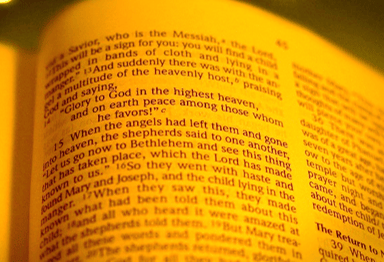
One painstaking interview at a time, Luke pieced together the story. He’d never known Jesus during his earthly life, but was able to sit with Jesus’ mother over two whole days, soaking up her precious memories of his childhood. Jesus’ friends never tired of repeating his sayings and recounting incidents of his time amongst them. The result was Luke’s well-loved Gospel that sharpened the detail of many of the stories. He included incidents that we read nowhere else, such as the resurected Jesus’ appearance to the two disciples on the Emmaus road.
-o-O-o-
What a faith-building ministry Luke had! His is my favourite Gospel, but how much I love his Acts of the Apostles! We’d be so much the poorer without this masterly account of the early church and the spread of God’s kingdom across the Mediterranean lands. Acts provides the scaffold around which the New Testament letters are woven, meaning we can better understand their context.
Almost seven centuries later, the Venerable Bede wrote his masterly accounts of the early church in England. He brought to life Aidan, Cuthbert and the Celtic Church from which so much inspiration is being drawn in modern times.
-o-O-o-

Reporting and recounting faith-building stories is a ministry in itself. I’ve recently read ‘Christ and the Kalashnikov’, written by Paul Alkazraji about the church in post-communist Albania in the 1990’s. As a Christian journalist, Paul was invited to report how God used a young couple, Ian and Caralee Loring, to establish and build up the church in southern Albania. It’s an exciting read, but honestly reports the struggles and the constant crises involved in establishing a work amongst a broken people, amidst chaos, corruption and societal breakdown.
Paul found it challenging to piece together his account, as his busy subjects proved hard to pin down! I’m so glad he persisted. The surprising sequel was that he returned to Albania, married a local lady and joined the same missionary organisation as the Lorings, to set up a newspaper. Several years later, he himself became the pastor of a church in a rural village! He later composed a (fictional) novel, The Migrant, that gives you an insight into his surroundings, of his life and ministry, and of the people’s struggles.
-o-O-o-
And this is my motivation for writing. I hope that, amongst the pathos and humour of my blogposts, you will find faith – or, if you already believe in Jesus Christ, that your faith will be encouraged.

